An Old Galvanized Service Line Corrodes Through and Begins Leaking in Rock Hill, SC
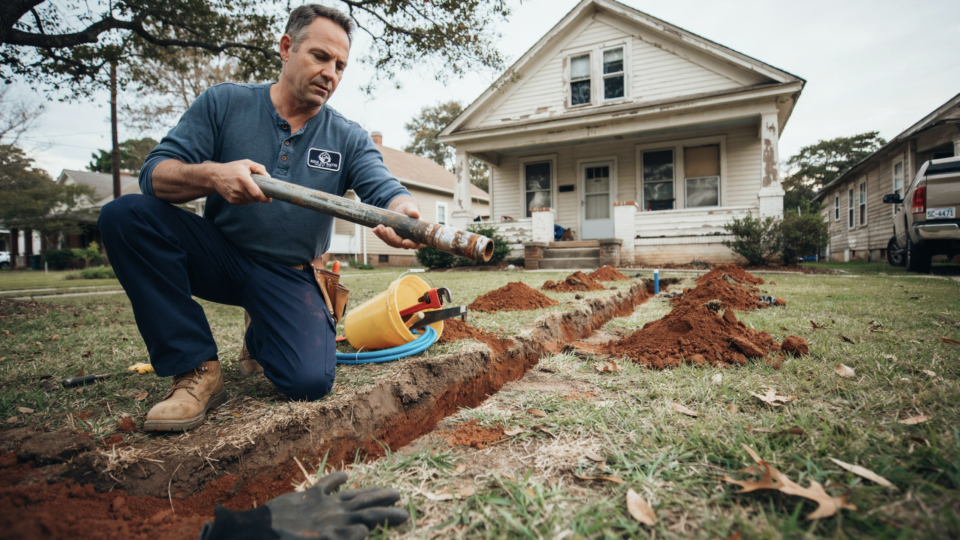
In an established Rock Hill neighborhood built up decades ago, a homeowner started noticing a faint metallic smell near the side of the house. There was also a small area of soil that never quite dried out. The house was built in the early 1980s and has had two previous owners. Neither one, as far as records showed, had ever replaced the original service line running from the street. That turned out to be part of the problem.
A Line That Had Outlasted Its Expected Lifespan
Older homes in this part of Rock Hill were often built with galvanized steel service lines. It was a common material at the time, but it corrodes from the inside out over the decades, long before any outward sign appears. Galvanized pipe was standard in residential construction for decades before copper and later plastic materials became the norm. Homes built before the mid-1980s in this part of Rock Hill are the ones most likely to still have it in the ground. The zinc coating that protects the steel underneath breaks down over time, especially in the region’s clay-heavy soil. That accelerates the corrosion from the outside as much as from mineral buildup inside the pipe. The transition away from galvanized pipe in residential construction happened gradually through the 1970s and 1980s, as copper became more affordable and, later, as plastic piping systems entered the market. Homes built squarely in the middle of that transition sometimes have galvanized service lines even when the interior plumbing was updated to copper at some point over the years. The two systems were rarely replaced on the same schedule.
When a plumber examined the pipe material and the depth it was buried at, the line was estimated to be around 43 years old. That’s well past the point where galvanized pipe typically starts failing. It’s a familiar story with pipe this old: fine for decades, until suddenly it wasn’t.
Confirming the Corrosion Was the Cause
The smell and the damp soil were consistent with water escaping slowly through pitted corrosion, rather than a single clean break. That’s typical of galvanized pipe nearing the end of its life. A small section was cut out and examined directly. It showed the kind of pitted, flaking interior surface that’s typical of galvanized pipe near failure, narrower in some spots than others where corrosion had eaten away more of the pipe wall. Testing confirmed it as a leaking main water line. Corrosion was scattered along enough of the pipe’s length that a single point repair wasn’t going to hold for long, even if it stopped the immediate leak.
Weighing a Patch Against a Full Replacement
Galvanized lines this old tend to have more than one weak spot, even when only one is actively leaking at the moment someone calls. The plumber laid out both paths. Patch the current leak and accept the likelihood of another failure somewhere else on the line before long, or replace the full run now while the excavation was already open. Cost was part of the conversation too. A single point repair on a galvanized line often runs less upfront than a full replacement. But if the rest of the pipe is corroding at a similar rate, that lower initial cost can turn into two or three separate repairs spread across the following year or two. Given the pipe’s age, a fuller replacement made more sense here. The completed job came to $600. The homeowner also asked whether the age of the line affected homeowner’s insurance considerations. The plumber suggested checking with their provider directly, since some policies treat gradual deterioration differently than a sudden pipe failure.
The repair took more than a single quick visit to plan and carry out. The homeowner noted what mattered most during that stretch was simply staying informed. “I got a call every time something changed, even small updates,” they recalled. “I never felt like I was sitting around wondering what was happening underground.”
Once the new line was in and pressure-tested, the crew walked the homeowner through the completed work before closing the trench. They pointed out where the old galvanized pipe had been swapped for the new material along its full run.
What Older Homes Should Watch For
A metallic odor near the ground, a patch of soil that stays damp without explanation, or discolored water are all worth paying attention to. That’s especially true in a home old enough to still have its original service line. Galvanized pipe doesn’t fail all at once in most cases. It corrodes gradually, and a single leak is often a sign that the rest of the line isn’t far behind. A simple way to check a home’s service line material without digging is to look at the exposed pipe coming into the house near the meter or crawlspace access. Galvanized pipe has a dull gray, threaded appearance. Copper is reddish and smooth, and plastic lines are usually blue or black.
Discolored water, particularly a brownish or rusty tint right after the water’s been off for a while, is another common sign of galvanized pipe nearing the end of its service life. That can show up even before any leak develops. Homes with slab foundations from the same era can show comparable warning signs. It’s worth knowing when the issue calls for slab leak repair instead of a service line replacement.
If your home still has its original galvanized line, it’s worth having someone take a look before a small leak becomes several.