Emergency Plumbing Service in Charlotte, NC
Clogged Garbage Disposal
A garbage disposal that has stopped working brings the kitchen to a halt quickly. Whether it is jammed and humming, completely silent, draining slowly, or leaking beneath the sink, a malfunctioning disposal is one of those problems that is hard to work around — and one that homeowners frequently make worse by trying to fix it the wrong way. This page covers what causes garbage disposal problems in Charlotte homes, what you can safely do before calling a technician, and when the disposal needs professional repair or replacement.
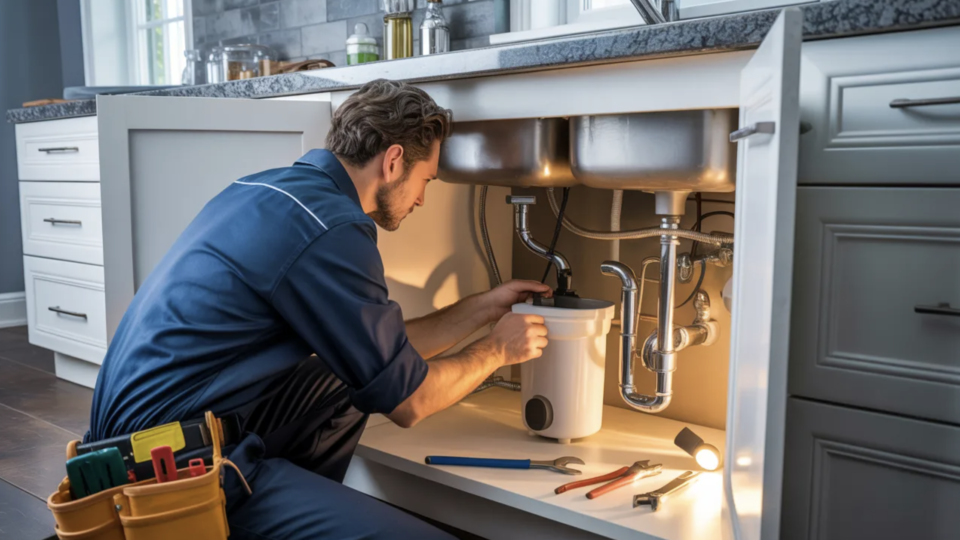
Garbage disposal repair in Charlotte, NC for jammed units and kitchen sink issues. We fix problems quickly and restore proper operation.
A garbage disposal that has stopped working brings the kitchen to a halt quickly. Whether it is jammed and humming, completely silent, draining slowly, or leaking beneath the sink, a malfunctioning disposal is one of those problems that is hard to work around — and one that homeowners frequently make worse by trying to fix it the wrong way. This page covers what causes garbage disposal problems in Charlotte homes, what you can safely do before calling a technician, and when the disposal needs professional repair or replacement.
Do This Before Calling — The Reset Button
Many garbage disposal calls turn out to be a tripped reset button, which is a simple fix that takes thirty seconds and requires no tools.
When a disposal overloads — from too much food at once, a jam, or running dry — it trips an internal thermal overload switch that cuts power to the motor. The disposal goes completely silent and does not respond to the wall switch.
Before calling for service, check the reset button:
Step 1 — Make sure the wall switch is in the off position.
Step 2 — Look at the bottom of the disposal unit under the sink. There is a small red or black button on the underside of the unit — this is the reset button.
Step 3 — Press it firmly until you feel it click. If it was tripped, it will click into place.
Step 4 — Turn the cold water on and then try the wall switch.
If the disposal runs normally after this, the reset was all that was needed. If it trips again quickly, the underlying cause — usually a jam or a motor that is failing — still needs to be addressed.
The Allen Wrench Fix for a Jammed Disposal
If the disposal hums when switched on but does not spin, the grinding plate is jammed — something is preventing the impellers from rotating. A humming disposal that is not spinning should be switched off immediately. Running the motor against a jam overheats it and can burn out the motor.
Most garbage disposals have a manual unjam port at the center of the bottom of the unit — a hex-shaped socket that accepts a standard Allen wrench (usually 1/4 inch).
Step 1 — Switch the disposal off at the wall.
Step 2 — Insert the Allen wrench into the socket on the bottom of the unit.
Step 3 — Work the wrench back and forth until the grinding plate moves freely in both directions. This manually rotates the plate and dislodges whatever is causing the jam.
Step 4 — Use tongs or pliers — never your hand — to remove any debris or object from inside the disposal through the drain opening.
Step 5 — Press the reset button, turn on the cold water, and try the wall switch.
If the Allen wrench port is absent or this procedure does not free the jam, or if the jam returns quickly after clearing, the problem is either a persistent foreign object or a worn motor that is no longer strong enough to handle normal use.
What Actually Jams and Clogs a Garbage Disposal
Understanding what causes disposal problems is the most effective way to prevent them — and to explain what a technician will be looking for during a service call.
Hard food items that should not go in
The most common jam culprits are items that are too hard or too fibrous for the disposal to process. Fruit pits — peach, cherry, avocado — are dense enough to stop the grinding plate entirely. Poultry bones and large meat bones do the same. Ice cubes are often recommended as a cleaning method but can also cause jams if the disposal is old or the motor is weak.
Fibrous vegetables
Celery, artichokes, asparagus, and corn husks have long stringy fibers that wrap around the impellers and grind plate rather than being cut by them. Over time these fibers accumulate, reducing the effective clearance of the grinding chamber and eventually jamming the unit. Onion skins have a similar effect — the thin papery outer layers pass through the grinder but catch on the drain screen downstream.
Pasta, rice, and starchy foods
Cooked pasta and rice continue to expand in water after going down the disposal. Starches from these foods also create a thick paste that coats the inside of the drain pipe beneath the disposal and accumulates with each use. This is one of the most common causes of a disposal drain that is slow rather than completely blocked — the pipe is progressively narrowing from starchy buildup.
Grease and cooking fat
Grease should never go down any drain, but the disposal drain is a particularly poor destination. The warm water used while running the disposal keeps grease liquid as it passes through the unit — but it cools and solidifies a short distance down the drain pipe, accumulating at bends and narrowings in the line. Over months this buildup restricts the disposal drain significantly.
Foreign objects
Bottle caps, pull tabs, twist ties, small utensils, glass fragments, and small toys from children are among the most common objects found jammed in disposal units. Metal objects — bottle caps and utensils — are the most likely to cause a hard jam that the motor cannot overcome and that requires manual extraction before the unit will work again.
A utensil that drops in while the disposal is running is a safety emergency — switch the unit off at the wall immediately and do not reach in.
Eggshells and coffee grounds
These are among the most commonly cited items that homeowners believe are safe or even beneficial for the disposal — they are not. Eggshell membranes wrap around the grinding components similarly to fibrous vegetables. Coffee grounds pass through the disposal easily but accumulate in drain pipes, particularly at P-traps, creating a dense sludge.
Types of Garbage Disposal Problems
Disposal is completely silent — does not hum, does not spin
The unit is not receiving power. Check the reset button on the bottom of the disposal first. If that does not fix it, check that the outlet under the sink is receiving power (disposals are typically plugged into a switched outlet in the cabinet). If power is confirmed and the reset button does not restore function, the motor has likely failed.
Disposal hums but does not spin
The motor is receiving power but the grinding plate is jammed. Follow the Allen wrench unjam procedure above. If the jam clears but the disposal stalls again quickly, a foreign object may still be in the chamber, or the motor is worn and no longer strong enough to handle normal loads.
Disposal drains slowly
The blockage is downstream of the disposal — in the drain pipe beneath the sink rather than in the disposal unit itself. Starchy buildup, grease accumulation, and debris that passed through the disposal collect in the P-trap and the horizontal drain pipe leading to the wall. This drain line can typically be cleared with a drain snake or by cleaning the P-trap.
Disposal leaks from the sink flange
The sink flange is the metal ring that connects the disposal to the sink drain opening. Over time, the plumber’s putty seal beneath the flange dries and cracks, or the mounting bolts loosen, allowing water to leak down from the flange connection. This shows up as water dripping from the top of the disposal unit. Tightening the mounting bolts or resealing the flange with fresh plumber’s putty resolves this.
Disposal leaks from the side
A leak from the side of the disposal — typically from one of the connections on the body of the unit — is usually at the dishwasher drain inlet or the discharge pipe connection. These connections can loosen over time and may need to be tightened or have the gasket replaced.
Disposal leaks from the bottom
A leak from the bottom of the disposal body — not from a connection but from the unit itself — indicates a failed internal seal. The internal seals on a disposal are not serviceable separately. A bottom leak means the unit needs to be replaced.
Disposal runs but does not grind effectively
The impellers — the blunt fins on the grinding plate that force food waste against the grinding ring — are worn. Over years of use, impellers lose their edge and become less effective at processing food waste. A disposal that runs but leaves large food pieces intact and drains poorly is typically at the end of its useful life.
Repair vs. Replace — How to Decide
Garbage disposals have a typical lifespan of 8–15 years depending on the brand, usage level, and how well they have been maintained. The repair vs. replace decision follows a simple pattern:
If the disposal is under 5 years old and the problem is a jam, a drain clog, or a flange seal — repair makes sense. These are fixable problems that do not indicate a failing unit.
If the disposal is 5–10 years old and the motor has failed or is weak, weigh repair cost against replacement cost. A new mid-range disposal installed typically costs $250–$450 — if a motor repair approaches that figure, replacement is the better value.
If the disposal is over 10 years old, replacement is almost always the right answer regardless of what has failed. A unit this age is likely to develop another problem soon after repair.
A bottom leak — from the disposal body itself — is always a replacement regardless of age. Internal seal failures are not repairable.
What to Look for in a Replacement Disposal
When replacing a disposal, a few specifications matter more than brand name:
Motor size — measured in horsepower. A 1/2 HP motor handles light use in a household of one or two people. A 3/4 HP motor is appropriate for most family households. A 1 HP motor handles heavy use, harder food waste, and households that use the disposal frequently. Upgrading motor size during replacement is usually worth the modest additional cost.
Grinding stages — higher-end disposals use two-stage grinding, which produces finer particles that are less likely to accumulate in drain pipes and less likely to cause jams.
Stainless steel components — grinding chambers and components made of stainless steel resist corrosion better than galvanized components and last longer in Charlotte’s humid environment.
Sound insulation — disposals vary significantly in noise level. Insulated models are noticeably quieter and worth considering for kitchens adjacent to living areas or bedrooms.
How Much Does Garbage Disposal Service Cost in Charlotte, NC?
- Service call and jam clearing: $100–$175
- Drain cleaning (P-trap and disposal drain line): $100–$200
- Sink flange reseal: $100–$175
- Disposal connection leak repair: $75–$150
- Disposal replacement (unit plus labor, mid-range): $250–$450
- Disposal replacement (unit plus labor, premium 1 HP): $400–$650
Labor costs in Charlotte vary depending on access, whether additional drain work is needed, and whether the electrical connection requires any modification.
Serving Charlotte, NC and Surrounding Areas
We provide garbage disposal repair and replacement service in Charlotte, NC and nearby communities including Matthews, Huntersville, Pineville, Concord, Gastonia, Mint Hill, Mooresville, Rock Hill, Fort Mill, and Indian Land. Same-day service is available for disposal and kitchen drain issues throughout the Charlotte metro area.
Frequently Asked Questions
My disposal just stopped working with no warning. What is the most likely cause?
Check the reset button on the bottom of the unit first — a tripped thermal overload is the most common cause of a disposal that suddenly goes silent. If the reset button does not restore function, check that the outlet under the sink has power. If both check out and the unit is still silent, the motor has likely failed.
Is it safe to reach into the disposal to remove a jam?
No — never put your hand into the disposal, even when it is switched off at the wall. The wall switch can be turned on accidentally, and the grinding components can cause serious injury. Use tongs, needle-nose pliers, or a retrieval tool to remove objects from the chamber.
Can I use chemical drain cleaners to clear a slow disposal drain?
It is not recommended. Chemical drain cleaners are corrosive and can damage the rubber components inside the disposal and the drain connections. A drain snake or manual P-trap cleaning is the right approach for a slow disposal drain.
Why does my disposal smell bad even after running it?
Food residue accumulates in the grinding chamber and on the underside of the splash guard — the rubber flap at the drain opening. Cleaning the underside of the splash guard with a brush and dish soap, and running ice cubes and citrus peels through the disposal periodically, reduces odor buildup. Persistent odors that do not respond to cleaning may indicate buildup deeper in the drain line.
How long should a garbage disposal last?
With average use and reasonable care — not putting inappropriate items in — a quality disposal lasts 10–15 years. Budget units and those subjected to frequent jams or hard items may last 5–8 years. A disposal that is requiring frequent resets or jams regularly is approaching the end of its useful life.
My disposal works but the kitchen sink drains slowly. Are they related?
Yes — the disposal drains into the same P-trap and drain line as the kitchen sink. Buildup in that drain line — from starchy foods, grease, or debris that passed through the disposal — restricts drainage for both the disposal and the sink. Cleaning the P-trap and drain line typically resolves slow drainage for both fixtures.
Can I install a garbage disposal myself?
A straightforward replacement of an existing disposal — same size, same mounting assembly — is a manageable DIY project for a mechanically comfortable homeowner. Adding a disposal where none existed, or running a new electrical circuit, requires a licensed electrician. If there is any uncertainty about the electrical connection or the drain configuration, professional installation is the safer choice.
Garbage disposal not working in Charlotte, NC? Call +1 (833) 865-1777 or use the Request Emergency Service form. Same-day service available throughout the Charlotte metro area.
More Services
Explore More Emergency Plumbing Services in Charlotte, NC and Surrounding Areas
Browse other common emergency plumbing issues homeowners in Charlotte, NC and surrounding areas may need help with.
Burst Pipe Repair
Fast dispatch for active leaks, burst pipe emergencies, and water damage concerns.
Drain Cleaning
Kitchen, bathroom, and main line drain issues handled with rapid local response.
Water Heater Problems
Hot water loss, tank leaks, and urgent system issues routed to local help fast.
Overflowing Toilet
Urgent toilet backup and overflow issues handled before they cause more damage.
Sewer Line Backup
Fast response for sewage backup warning signs, foul odors, and major drain blockages.
Emergency Leak Detection
Hidden leaks, ceiling water spots, and sudden pressure loss routed to local help quickly.
Slab Leak Repair
Warm floor spots, unexplained water use, and hidden pipe leaks under the slab checked quickly.
Main Water Line Leak
Sudden pressure loss, soggy yard areas, and urgent water line leaks routed for rapid response.