Emergency Plumbing Service in Charlotte, NC
Sewer Line Backup
A sewer line backup is the most serious drain emergency a homeowner can face. Unlike a single clogged fixture, a backed-up sewer line means the entire wastewater system in your home has nowhere to go. Sewage can push back up through the lowest drains in the house — floor drains, basement toilets, tubs — and cause significant contamination and water damage in a short amount of time. If you are seeing sewage backing up into your home right now, stop using all water immediately and call for emergency service.
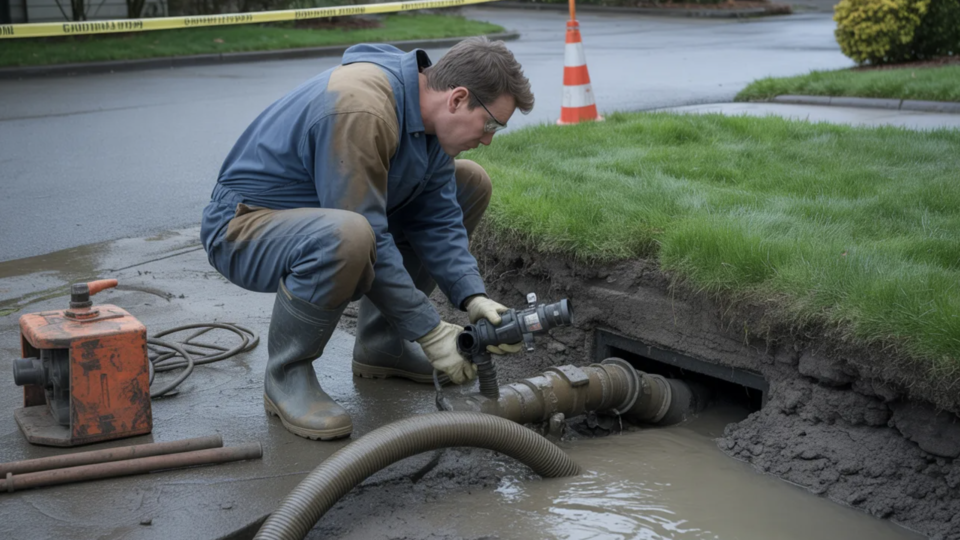
Sewer line backup repair in Charlotte, NC for foul odors, slow drains, and major blockages. We provide fast diagnosis and safe solutions.
A sewer line backup is the most serious drain emergency a homeowner can face. Unlike a single clogged fixture, a backed-up sewer line means the entire wastewater system in your home has nowhere to go. Sewage can push back up through the lowest drains in the house — floor drains, basement toilets, tubs — and cause significant contamination and water damage in a short amount of time. If you are seeing sewage backing up into your home right now, stop using all water immediately and call for emergency service.
Stop Using Water Right Now
If you suspect a sewer line backup, this is the single most important thing to understand: every time water goes down any drain in the house — toilet flush, sink, shower, washing machine, dishwasher — it has to go somewhere. With a blocked main sewer line, it has nowhere to go except back up into the home through the lowest available drain opening.
Stop all water use in the home immediately. That means no flushing, no running faucets, no laundry, no dishwasher. Then call for service.
How the Sewer System Works in Charlotte, NC
Understanding where your responsibility ends and the city’s begins matters when a sewer backup occurs.
Charlotte Water — the city’s water and sewer utility — maintains the public sewer mains running beneath streets and public easements throughout Mecklenburg County. From that public main, a private lateral line runs from the main to your home. That lateral line — from the city connection at the property line or easement all the way to your home’s foundation — is the homeowner’s responsibility.
This means if the blockage is in the city main, Charlotte Water handles it at no cost to you. If the blockage is in your lateral line — which is the case the vast majority of the time — it is your responsibility to have it cleared and repaired.
If you are experiencing a sewer backup, Charlotte Water has a 24-hour emergency line you can call to check whether a problem has been reported on the public main in your area. But in most cases, the problem is in the private lateral, not the city main.
Why Sewer Line Backups Are Common in Charlotte, NC
Several factors specific to Charlotte make sewer line backups more common here than in many other metros.
Tree roots
This is the leading cause of sewer line problems in Charlotte’s established neighborhoods. The city has extensive tree cover — mature oaks, sweetgums, maples, and other large trees are common throughout Dilworth, Myers Park, Elizabeth, Cotswold, Plaza Midwood, and NoDa. The roots of these trees extend far beyond the canopy in search of moisture and nutrients, and the wastewater inside sewer lateral lines is an ideal source. Roots infiltrate lines through joints, cracks, and any imperfection in the pipe. Once inside, they grow and expand, narrowing the pipe over years until flow is severely restricted or completely blocked.
A root intrusion does not happen overnight. It develops gradually over years, which is why many homeowners are caught off guard — the line was working fine, and then suddenly it is not. By the time a backup occurs, roots have typically been growing inside the pipe for a long time.
Aging pipe materials
Homes built before the mid-1980s in Charlotte commonly have sewer lateral lines made of clay tile or cast iron. Clay tile joints crack and separate as soil shifts over decades — Charlotte’s expansive clay soil accelerates this. Cast iron corrodes from the inside, eventually developing rough surfaces that catch debris and sediment. Neither material lasts indefinitely, and many original lateral lines in Charlotte’s older neighborhoods are well past their expected service life.
Homes built from the 1980s through early 2000s often have PVC lateral lines, which are more durable and root-resistant — but even PVC can crack or separate at joints if soil movement is significant.
Charlotte’s clay soil
The expansive clay soil throughout the Charlotte metro shrinks and swells with moisture changes. Over decades, this soil movement shifts underground pipes, causes joint separation, and creates the cracks that roots exploit. This is a factor that affects all underground plumbing in the region, not just older homes.
Grease and debris buildup
Fats, oils, and grease poured down kitchen drains accumulate on the inside of the sewer lateral over years, progressively narrowing the pipe. Combined with other debris — wipes, paper products, food particles — this buildup can eventually restrict or block the line entirely. Grease-related backups are more common in homes where cooking grease has been regularly disposed of down the drain.
Low points and pipe sags
Over time, sections of a sewer lateral can sag — a condition called bellying — where soil settles beneath the pipe and creates a low point where water pools. Solids accumulate in these low spots rather than flowing through, creating a recurring backup point. Camera inspection is the only way to identify a belly in the line.
Signs of a Sewer Line Backup
Multiple drains slow or stopped at the same time
When the main sewer line is blocked or severely restricted, all fixtures drain into that same line. Multiple drains failing simultaneously is the clearest indicator that the problem is in the main line, not individual fixtures.
Sewage backing up into the lowest drains
When the main line is completely blocked, backed-up sewage finds the path of least resistance back into the home — typically the lowest drain openings: floor drains in the basement or utility room, the lowest-level toilet, or a ground-floor shower or tub. Sewage appearing in these fixtures when you have not used them is a clear sign of main line backup.
Toilet gurgles when the washing machine drains
The washing machine discharges a large volume of water quickly. If that water cannot flow freely through the main line, it pushes air back through nearby drain connections — causing the toilet to bubble and gurgle. This is one of the earliest warning signs of a developing main line restriction.
Slow drains on the lowest floor only
If the ground floor drains are slow but upper floor fixtures are fine, the blockage may be in the lower section of the lateral line or at the point where the lateral exits the foundation. Blockages closer to the street affect the entire home equally.
Sewage odors from drains
A persistent sewage smell from floor drains or the lowest fixtures — even without visible backup — can indicate a partial blockage where gases are being forced back through the system.
Wet spots or depressions in the yard
If the sewer lateral has cracked or separated underground, wastewater can saturate the surrounding soil. Signs include unexplained wet areas in the yard, soft or spongy ground along the path from the house to the street, or an area of unusually lush green grass over the line.
How Sewer Line Backup Is Diagnosed and Cleared
Step 1 — Locate the cleanout
The sewer cleanout is an access point — typically a capped pipe at ground level near the foundation or in the yard — that allows direct access to the sewer lateral without going through a fixture. Clearing through the cleanout is faster and cleaner than going through a toilet or floor drain. Many Charlotte homes built before 1980 do not have an accessible cleanout, which adds a step to the process.
Step 2 — Clear the blockage
Depending on the nature of the blockage, a motorized drain auger (also called a sewer snake) or hydro-jetter is used to clear the line. An auger cuts through or retrieves the obstruction. Hydro-jetting uses high-pressure water to scour the pipe walls — more effective for grease buildup and root intrusion where material is coating the interior of the pipe rather than forming a single blockage.
Step 3 — Camera inspection
After clearing, a sewer camera inspection is strongly recommended to assess the condition of the line. Clearing a backup without inspecting the pipe tells you the line is flowing again — it does not tell you why it backed up or whether the pipe is damaged. Camera inspection reveals root intrusion, pipe cracks, joint separation, bellying, and the overall condition of the lateral. This determines whether the line needs repair or replacement, or whether clearing is sufficient for now.
Sewer Line Repair vs. Replacement
Once a camera inspection identifies a problem, the decision is whether to repair or replace the affected section.
Spot repair — if the problem is localized to a specific section of pipe, that section can be excavated and replaced without disturbing the entire lateral. Cost-effective when damage is limited to one area.
Pipe lining (CIPP) — cured-in-place pipe lining installs a resin-coated liner inside the existing pipe that cures into a new pipe within the old one. No excavation required in most cases. Good for pipes with widespread cracking or joint separation that are otherwise in reasonable condition. Not suitable for collapsed pipes or severe bellying.
Full lateral replacement — when the pipe is severely deteriorated throughout its length, full replacement is the right answer. In Charlotte, this typically involves excavating a trench from the foundation to the city connection. More disruptive and more expensive, but it solves the problem permanently with new pipe that has a full expected lifespan.
How Much Does Sewer Line Service Cost in Charlotte, NC?
- Sewer line clearing with auger: $250–$450
- Hydro-jetting (main sewer line): $350–$650
- Camera inspection of sewer lateral: $150–$300
- Cleanout installation (if none exists): $400–$800
- Spot repair of sewer lateral: $1,500–$4,000
- Pipe lining (CIPP, per foot): $80–$250
- Full lateral replacement: $4,000–$12,000 depending on length, depth, and site conditions
Sewage cleanup and remediation, if backing up into the home caused contamination, is a separate cost handled by water damage restoration companies and is typically covered by homeowner’s insurance.
Sewer Backup and Homeowner’s Insurance
Standard homeowner’s insurance policies typically do not cover sewer backup damage unless you have a specific sewer backup rider or endorsement added to your policy. This coverage is relatively inexpensive to add and is worth carrying — the cost of sewage cleanup and remediation in a finished basement or lower-level room can reach tens of thousands of dollars.
If you have sewer backup coverage and sewage has entered your home, document everything with photos and video before any cleanup begins, and contact your insurance company before work starts.
Serving Charlotte, NC and Surrounding Areas
We provide sewer line backup service in Charlotte, NC and nearby communities including Matthews, Huntersville, Pineville, Concord, Gastonia, Mint Hill, Mooresville, Rock Hill, Fort Mill, and Indian Land. Emergency service is available 24 hours a day, 7 days a week throughout the Charlotte metro area.
Frequently Asked Questions
How do I know if the blockage is in my lateral line or the city main?
Call Charlotte Water’s 24-hour line to ask if there are any reported issues on the main in your area. If the city main is clear, the blockage is almost certainly in your private lateral line. A technician can also confirm this by accessing the cleanout and checking which direction the blockage is.
Can sewer line backups cause permanent damage to my home?
Yes. Sewage is a Category 3 contamination (the most serious level) and poses health risks. Materials that come into contact with sewage — flooring, drywall, insulation — typically need to be removed and replaced rather than cleaned. The faster the backup is addressed and the area is dried and remediated, the more can be saved.
How often should I have my sewer lateral cleaned preventively?
For homes in older Charlotte neighborhoods with mature trees nearby, a preventive cleaning every 2 years is a reasonable approach. If a camera inspection has shown root intrusion, annual or biannual cleaning is appropriate until a permanent repair is made.
Is hydro-jetting better than snaking for root intrusion?
For roots, hydro-jetting is more effective — it removes root material from the pipe walls rather than just cutting through it. However, a camera inspection before and after is important to assess how much root material was removed and whether pipe damage requires repair.
My sewer backed up once and then cleared on its own. Should I still call?
Yes. A backup that appears to clear itself usually means the obstruction shifted enough to allow flow temporarily — it has not cleared. The blockage is still there and will back up again, often at a worse time. A camera inspection after any backup is the right approach.
Can tree roots really grow into a sewer pipe?
Yes, and it is more common in Charlotte than most homeowners realize. Roots enter through tiny cracks and joint imperfections and grow toward the moisture inside the pipe. Over several years, a hairline crack becomes a significant root mass that chokes the line. Homes with large oaks or sweetgums in the yard, or adjacent to properties with mature trees, are at particular risk.
Sewer backing up in Charlotte, NC? Call +1 (833) 865-1777 or use the Request Emergency Service form. Available 24/7 for sewer emergencies throughout the Charlotte metro area.
More Services
Explore More Emergency Plumbing Services in Charlotte, NC and Surrounding Areas
Browse other common emergency plumbing issues homeowners in Charlotte, NC and surrounding areas may need help with.
Burst Pipe Repair
Fast dispatch for active leaks, burst pipe emergencies, and water damage concerns.
Drain Cleaning
Kitchen, bathroom, and main line drain issues handled with rapid local response.
Water Heater Problems
Hot water loss, tank leaks, and urgent system issues routed to local help fast.
Overflowing Toilet
Urgent toilet backup and overflow issues handled before they cause more damage.
Emergency Leak Detection
Hidden leaks, ceiling water spots, and sudden pressure loss routed to local help quickly.
Clogged Garbage Disposal
Jammed garbage disposals, backed-up kitchen sinks, and grinding issues handled with fast local help.
Slab Leak Repair
Warm floor spots, unexplained water use, and hidden pipe leaks under the slab checked quickly.
Main Water Line Leak
Sudden pressure loss, soggy yard areas, and urgent water line leaks routed for rapid response.