Fibrous Food Scraps Create a Downstream Kitchen Clog in Gastonia, NC
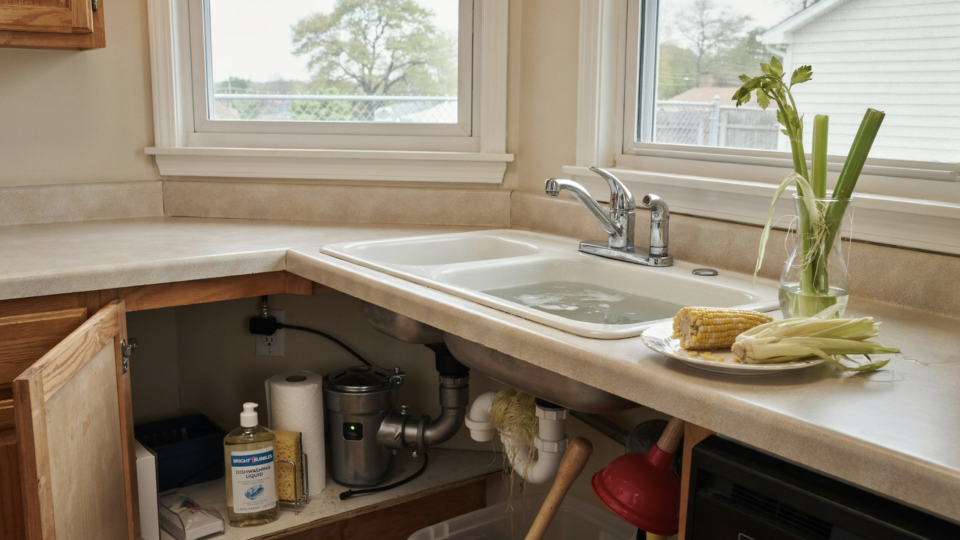
Fibrous Food Scraps Create a Downstream Kitchen Clog in Gastonia, NC
Celery strings and corn husk fibers don’t look like much going down a garbage disposal one at a time. But in a home in a residential area of Gastonia, months of both went through the same kitchen sink. By late spring they’d knitted together into a downstream clog that no amount of plunging could touch. The homeowner had been cooking more at home since the start of the year, leaning on fresh vegetables and corn on the cob as weeknight staples. They had assumed, reasonably enough, that a working garbage disposal meant the kitchen sink could handle whatever went into it. The disposal itself first seemed like the problem, since it ran fine but the sink still backed up every time it was used. That left a few inches of graying water sitting in the basin after every meal.
When the Disposal Runs But the Sink Still Backs Up
The technician’s first question wasn’t about the disposal at all. It was about the sink behind it. A disposal that hums along normally, grinds food without jamming, and still leaves standing water in the sink usually isn’t the actual problem. In that situation, the clog has moved past the disposal into the branch line beyond it. Fibrous foods like celery, corn husks, onion skins, and potato peels are common culprits because they don’t break down the way softer scraps do. Instead they wrap around themselves and anything else in the line, gradually building a mat that traps grease and smaller debris until the passage narrows to almost nothing. Unlike a hair clog in a bathroom drain, this kind of buildup often grows slowly enough that nobody notices until the sink is nearly unusable. Each individual meal only adds a small amount of fiber to what’s already collecting downstream.
Confirming the Clog Was Downstream
The technician started by running the disposal with water flowing to confirm it wasn’t jammed. He checked for the telltale hum-without-grinding sound that would point to a mechanical problem inside the unit itself rather than something further down the line. With the disposal cleared as a suspect, the technician traced the line with a camera to see where the actual restriction sat. The fibrous mass showed up a few feet past the disposal connection, in the horizontal run leading toward the main stack. Fibrous material tends to catch there because the pipe transitions from a steep drop to a flatter run. That shift gives strands of celery and husk fiber a chance to snag on the joint rather than washing straight through. With the location confirmed, this was a straightforward call for drain cleaning service rather than any disposal repair or replacement, since the unit itself was working exactly as it should.
Why Fibrous Buildup Behaves Differently Than Grease
Part of what the technician explained on site was why this kind of clog needed a different approach than the grease-based buildup that shows up in most kitchen line calls. Grease coats the inside of a pipe in layers, gradually narrowing the passage the way plaque narrows an artery. It usually responds well to a straightforward cable pass. Fibrous material behaves more like rope than residue. It tangles, and it holds its shape. It can also wrap tightly enough around a cable head that pulling back too aggressively just drags the whole mass a few feet without actually breaking it apart. That’s why the technician worked the auger through in short, controlled passes rather than one long run. He checked the cable head each time to see how much material had wound around it, adjusting the approach based on what came back.
Clearing the Line and Documenting the Fix
Using a cable auger, the technician cleared roughly 27 feet of line. He broke up the fibrous mat in sections and flushed the debris through with water between passes, rather than trying to pull the whole mass out in one motion. Pulling it out in one motion risks leaving stringy fragments caught further down. Because the disposal side was already confirmed clear, the downstream cleaning itself moved quickly. The whole visit was finished that same day for $320. The technician took photos of the buildup pulled from the line before disposing of it, at the homeowner’s request. He laid the fibrous mat out on a paper towel so it was clear just how much material had accumulated in one section of pipe.
“He took pictures of everything he pulled out so I’d have a record of it,” the homeowner mentioned. “It’s a small thing, but it made me trust that he wasn’t exaggerating what was actually going on down there, and it gave me something concrete to point to when I explained to my partner why we needed to change how we use the disposal.” That documentation ended up being the detail the homeowner noted first when describing the visit to a neighbor.
For anyone running fibrous scraps through a garbage disposal regularly, it’s worth remembering that a disposal running smoothly doesn’t rule out a clog forming just past it. Cutting celery, corn husks, and onion skins into smaller pieces before they go down the drain reduces the odds of this kind of downstream buildup. Skipping the disposal for them entirely and composting instead works too. Running the water for a good ten to fifteen seconds after the disposal finishes grinding also helps. It flushes loosened fiber further down the line, instead of letting it settle right past the connection point. If the disposal itself starts jamming or humming without grinding, that’s a separate issue. It’s worth addressing as garbage disposal repair before it compounds into a drain clog too.