Emergency Plumbing Service in Charlotte, NC
Main Water Line Leak
The main water line is the single pipe that brings all water into your home from the city supply. When that line fails, the impact is immediate and total — no water to any fixture, appliance, or faucet in the house. But a main water line leak is often more complicated than a complete failure. Many main line problems develop slowly, leaking underground for weeks or months before a homeowner realizes anything is wrong. By the time the signs become obvious, significant erosion, soil saturation, and sometimes pavement or yard damage has already occurred. If you suspect a main water line problem in Charlotte, NC, fast professional assessment is essential.
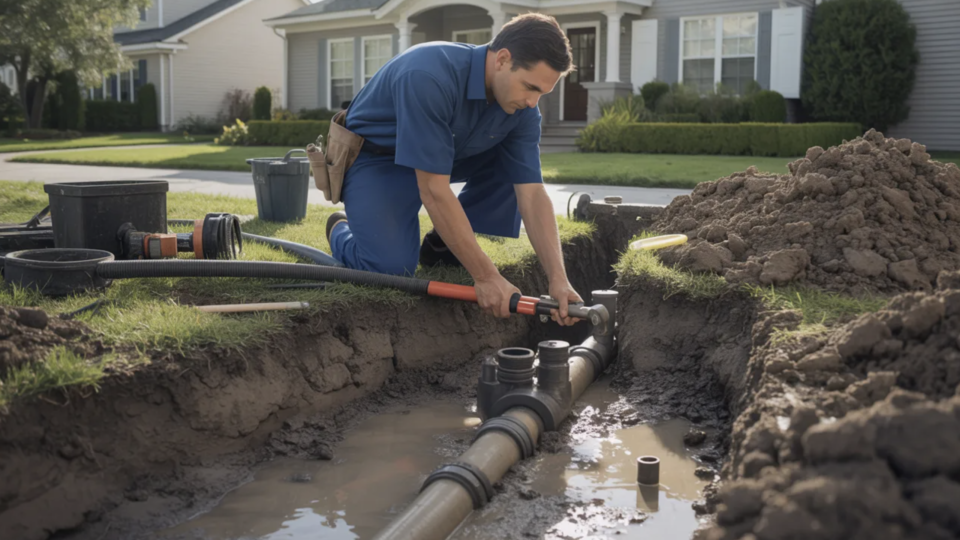
Main water line repair in Charlotte, NC for pressure loss and underground leaks. Fast emergency service to restore your water supply.
Main Water Line Leak in Charlotte, NC — Emergency Detection and Repair
The main water line is the single pipe that brings all water into your home from the city supply. When that line fails, the impact is immediate and total — no water to any fixture, appliance, or faucet in the house. But a main water line leak is often more complicated than a complete failure. Many main line problems develop slowly, leaking underground for weeks or months before a homeowner realizes anything is wrong. By the time the signs become obvious, significant erosion, soil saturation, and sometimes pavement or yard damage has already occurred. If you suspect a main water line problem in Charlotte, NC, fast professional assessment is essential.
Understanding Who Is Responsible — Charlotte Water vs. the Homeowner
This is the first question that matters when a main water line problem occurs, because it determines who pays for the repair.
Charlotte Water — the city’s water utility, operated by the City of Charlotte and serving Mecklenburg County — owns and maintains the water main running beneath the street. From that public main, a service line runs to each home on the block. Charlotte Water owns the water meter and the connection at the main. Everything from the meter to the home’s foundation — and all plumbing inside the home — is the homeowner’s responsibility.
The boundary of responsibility is typically the water meter itself. The pipe on the street side of the meter belongs to Charlotte Water. The pipe on the house side of the meter is the homeowner’s private service line.
This means that in the vast majority of main water line calls, the problem is in the private service line — the homeowner’s responsibility — not in the city main. Charlotte Water will not repair or pay for work on the private service line, even if the leak is close to the meter.
If you suspect the problem may be on the city’s side of the meter — particularly if neighbors are also experiencing low pressure or outages — contact Charlotte Water’s 24-hour customer service line to report the issue and ask whether any problems have been reported in your area. But do not wait for that call if water is actively leaking or if your service is interrupted. Have the private line assessed at the same time.
What Is the Main Water Line and Where Does It Run
The main water line — also called the service line or water service lateral — is typically a single pipe running from the water meter near the street, beneath the yard, and into the home through the foundation wall or beneath the slab. In Charlotte, this pipe is usually buried 18–30 inches below grade, though depth varies depending on when the home was built and whether any yard grading has changed the depth over the years.
In homes built before the 1970s, the service line is most commonly lead, galvanized steel, or copper. Homes built from the 1970s through the 1990s typically have copper service lines. Homes built from the late 1990s onward are more likely to have PVC or PEX service lines.
The diameter of the service line is typically 3/4 inch to 1 inch for standard residential properties — larger for homes with higher demand or irrigation systems. The line runs under the front yard in most Charlotte properties, following a relatively straight path from the meter to the home.
Why Main Water Line Leaks Are Common in Charlotte, NC
Several factors specific to Charlotte create elevated risk for service line failures.
Expansive clay soil
Charlotte’s Piedmont clay soil is the single most significant factor. This soil swells when wet — sometimes dramatically — and contracts as it dries. The seasonal movement is continuous and cumulative over decades, shifting underground pipes, stressing joints, and gradually working pipe fittings loose. A service line that has been in the ground for 40 years in Charlotte’s soil has experienced thousands of cycles of expansion and contraction. The cumulative stress on fittings, joints, and the pipe itself is significant.
Age of pipe materials
Galvanized steel service lines — common in Charlotte homes built before the 1960s — corrode from the inside out. As the zinc coating degrades, the underlying steel rusts, and the interior of the pipe progressively narrows. Eventually the corrosion reaches the pipe wall and a leak develops. Galvanized service lines in Charlotte homes that have not been replaced are well past their expected service life.
Copper service lines, which replaced galvanized in most Charlotte homes from the 1960s onward, are more durable but still subject to corrosion — particularly electrolytic corrosion from stray electrical currents in the soil, and pitting corrosion from water chemistry. Copper service lines in Charlotte from the 1960s and 1970s are now 50–60 years old and increasingly prone to pinhole leaks.
Lead service lines
Some of Charlotte’s oldest homes — particularly in historic neighborhoods — may have original lead service lines, though Charlotte Water has been working to identify and replace these. Lead lines are soft, flexible, and prone to joint failures. If your home was built before 1940 and the service line has never been replaced, its material is worth identifying.
Root intrusion
Tree roots do not restrict themselves to drain lines. Supply line joints and fittings — particularly in older pipe materials with degraded seals — are also points where roots can infiltrate or where root pressure can damage the pipe. Charlotte’s extensive mature tree cover, particularly in established neighborhoods, creates a network of deep root systems that interact with underground pipes throughout the yard.
Ground movement from construction and traffic
In many Charlotte neighborhoods, nearby construction activity — new development, road work, utility installation — creates ground vibration and soil disturbance that can affect existing service lines. A pipe that had a marginal joint can fail when nearby excavation shifts the surrounding soil.
Signs of a Main Water Line Leak
Main water line leaks present differently depending on whether the leak is minor, moderate, or a major failure. Recognizing the early signs allows for repair before the problem escalates.
Sudden loss of water pressure throughout the home
When a service line fails significantly, water pressure drops throughout every fixture simultaneously. This is different from a single fixture with low pressure — when the main line is compromised, the entire home is affected equally. A sudden, unexplained pressure drop is a main line problem until proven otherwise.
Complete loss of water service
A catastrophic main line failure — a pipe that has split or separated at a joint — can stop water flow entirely. If water stops coming out of every fixture in the house at once and the street main is confirmed to be operating, the problem is in the private service line.
Unexplained spike in the water bill
A slow main line leak — a pinhole or a weeping joint — may not affect pressure noticeably but loses significant water volume continuously. Charlotte Water meters water monthly, and a leak running 24 hours a day adds up quickly. A bill increase of 30 percent or more with no change in usage is worth investigating. The water meter self-test confirms whether an active leak is present.
Water meter moving with all fixtures off
The standard leak self-test. Turn off all water-using appliances and fixtures, including the icemaker and irrigation system, and watch the water meter for 10–15 minutes. A moving meter with everything off confirms an active leak in the system. If the meter is moving and there are no obvious indoor leaks, the service line is the primary suspect.
Wet or soggy areas in the yard
A leaking service line saturates the soil above and around the leak point. This appears as a persistently wet patch in the yard — soft, spongy ground that does not dry out between rain events, or that is wet when surrounding areas are dry. The wet area is typically along the path from the water meter to the home’s foundation.
Unexplained lush or green strip of lawn
A slow service line leak may not produce obvious surface wetness in drier conditions, but it irrigates the soil above it continuously. A strip of unusually green, thick, fast-growing grass running from the meter toward the house — when surrounding areas are not as lush — is a classic subtle sign of a slow service line leak.
Sinkholes, depressions, or pavement cracks
A significant service line leak erodes soil over time, creating voids beneath the surface. These voids eventually cause the ground above to settle or collapse — producing depressions in the yard or, in cases where the line runs beneath a driveway or walkway, cracks and sinkholes in the pavement. Any unexplained ground settlement along the service line path warrants immediate investigation.
Discolored water
Water that appears brown, orange, or carries visible sediment after a period of no use — particularly first thing in the morning — can indicate corrosion inside the service line. In galvanized or aging copper lines, corrosion products enter the water stream. Discoloration that flushes clear after running the water for a minute or two suggests the problem is in the service line rather than the interior plumbing.
Dirt or sediment at fixtures
If soil or sand appears in water from fixtures — particularly after a pressure fluctuation or restoration of service — it indicates a crack or breach in the service line through which soil is being drawn into the pipe under pressure differentials.
Main Water Line Leak vs. Other Leak Sources
Before assuming a main line problem, ruling out other sources is part of a proper assessment.
A slab leak — a leak in a supply line beneath the foundation — shares some symptoms with a main line leak, particularly the moving water meter and the unexplained bill increase. The key difference is location: a slab leak does not produce yard wetness along the service line path, and the warm floor spots and interior signs of a slab leak are absent in a main line leak.
An irrigation system leak is another common source of meter movement and yard wetness. If the home has an in-ground irrigation system, isolating it — turning off the irrigation supply at the backflow preventer — and repeating the meter test confirms whether irrigation is contributing to the leak.
A leaking hose bib — an outdoor spigot — is sometimes overlooked as a source of water loss, particularly if it is on the side of the home not frequently seen. A hose bib with a failed packing can drip continuously without being obvious.
Professional assessment distinguishes between these sources quickly using pressure testing and systematic isolation of each branch of the supply system.
How Main Water Line Problems Are Diagnosed
Water meter test
The starting point for any suspected main line leak. With all fixtures and appliances off, a moving meter confirms an active leak. The rate of meter movement gives a rough indication of leak volume.
Pressure testing
The supply system is pressurized and monitored for pressure loss. Isolating the service line from the interior plumbing confirms whether the leak is in the service line or in the interior supply system.
Electronic pipe locating
Before any excavation, the route of the service line is mapped using electronic locating equipment. This confirms the pipe’s path, depth, and proximity to other utilities — essential information before any digging begins.
Acoustic leak detection
Specialized listening equipment amplifies the sound of water escaping from the pressurized service line. A technician walks the pipe route, identifying the point of maximum sound intensity — which corresponds to the leak location. For leaks that have not yet produced surface signs, acoustic detection is often the only way to pinpoint the leak before excavation.
Visual inspection at the meter and foundation
The meter box is inspected for signs of water — wet soil inside the box, a meter that is submerged, or water flowing toward the meter from the house side. The foundation penetration where the service line enters the home is also inspected for moisture.
Main Water Line Repair Options
Spot repair
If the leak is confirmed to be at a single, identified location — a failed joint, a localized section of corrosion, or a mechanical damage point — the pipe can be excavated at that location, the damaged section replaced, and the excavation backfilled and restored. This is the lowest-cost repair option and appropriate when the pipe is otherwise in good condition.
The limitation of spot repair is that it addresses only the confirmed leak point. If the service line is old and deteriorated throughout, a spot repair on one section is often followed by a failure at another point within a year or two.
Full service line replacement
When the pipe is old, the material is corrosion-prone, the pipe has failed in multiple locations, or the material is lead or severely deteriorated galvanized steel, full replacement of the service line is the right answer. A new line is trenched from the meter connection to the foundation, using modern pipe material — typically copper or PEX — with a full expected service life.
Full replacement is more disruptive and more expensive than spot repair but solves the problem permanently. For galvanized or lead service lines, and for copper lines with a history of multiple leaks, full replacement is always the better long-term investment.
Trenchless pipe replacement (pipe bursting)
In situations where excavating a full trench is particularly disruptive — across a finished driveway, under significant landscaping, or through an area with other buried utilities — pipe bursting offers a trenchless alternative. A new pipe is pulled through the old one, simultaneously fracturing the old pipe outward and installing the new one in a single operation. Pipe bursting requires access points at each end of the line but avoids the full trench. It is not suitable for all site conditions but eliminates much of the surface disruption of conventional replacement.
What Happens to the Yard and Driveway
Excavation for a main water line repair or replacement is one of the most disruptive aspects of the work, and Charlotte homeowners frequently ask about it before authorizing repairs.
A spot repair typically requires an excavation of 3–6 feet around the leak location — a relatively contained disruption. The hole is backfilled and compacted after repair, and surface restoration depends on what was above it: lawn grass typically recovers within a season, while concrete or paving requires patching.
Full service line replacement requires a trench from the meter to the foundation — potentially 40–80 feet or more depending on the lot. In Charlotte’s typical front-yard layouts, this trench runs across the lawn, and in some cases across a driveway or walkway. Trench excavation kills the grass above it, and compaction and settlement of backfill continues for several weeks after the work is done. Lawn restoration — seeding or sodding — is typically the homeowner’s responsibility after the plumbing work is complete.
Driveway or walkway sections that must be crossed are cut, the pipe is installed beneath, and the surface is patched. Asphalt is easier to patch than concrete, and patch color match is imperfect for both — this is an inherent limitation of any underground work beneath paved surfaces.
Trenchless pipe bursting significantly reduces surface disruption but is not always possible depending on site conditions and pipe configuration.
Main Water Line and Homeowner’s Insurance
Coverage for main water line repair varies significantly between policies and is worth understanding before a problem occurs.
Standard homeowner’s insurance policies typically cover sudden and accidental water damage that results from a main line failure — damage to the home, foundation, or structure caused by the leak — but typically do not cover the cost of the pipe repair itself or the excavation required to access it. The pipe repair is considered a maintenance item in most policy language.
Some insurance companies offer service line coverage as an endorsement or rider — a relatively inexpensive add-on that covers the cost of repairing or replacing the private service line. This endorsement is specifically designed for main water line and sewer lateral failures and is worth adding if your home has an aging service line.
Charlotte Water also has a partnership with HomeServe — a home warranty service — that offers water and sewer line protection plans specifically for Charlotte Water customers. This is separate from homeowner’s insurance and covers repair costs for private service lines. Whether this or a standard service line endorsement is the better value depends on the age of your service line and your specific coverage needs.
Document any main line failure with photos and video before repair begins, and contact your insurance company before authorizing excavation work to understand what your policy covers.
How Much Does Main Water Line Repair Cost in Charlotte, NC?
- Leak detection and diagnostic: $150–$350
- Spot repair (single location, accessible): $500–$1,500
- Full service line replacement (trenching, per linear foot): $50–$150
- Full service line replacement (typical residential, installed): $2,500–$6,000
- Trenchless pipe bursting (installed): $3,500–$8,000
- Driveway or sidewalk patching (if required): $500–$2,500 depending on material and area
- Permit fees (City of Charlotte): typically $100–$300 for service line replacement
Costs vary significantly depending on the length of the service line, depth of burial, site accessibility, proximity to other utilities, and whether paved surfaces must be crossed. A permit from the City of Charlotte is required for service line replacement work — this is pulled by the contractor and inspected by the city before backfilling.
Serving Charlotte, NC and Surrounding Areas
We provide main water line leak detection and repair service in Charlotte, NC and nearby communities including Matthews, Huntersville, Pineville, Concord, Gastonia, Mint Hill, Mooresville, Rock Hill, Fort Mill, and Indian Land. Emergency service is available 24 hours a day, 7 days a week throughout the Charlotte metro area.
Frequently Asked Questions
How do I know if the leak is on my side of the meter or Charlotte Water’s side?
The water meter is the dividing line. If water is leaking or pressure is lost on the house side of the meter — between the meter and your home — it is your responsibility. Charlotte Water’s 24-hour line can confirm whether any issues have been reported on the public main in your area, but do not delay assessment while waiting for that answer.
Can I continue using water in my home if the service line is leaking slowly?
For a minor leak that has not interrupted pressure, limited water use is typically possible while a repair is arranged. However, a leaking service line can deteriorate quickly — a small leak can become a major one without warning — and the soil erosion caused by even a slow leak continues around the clock. Prompt repair is always the right approach.
How long does main water line replacement take?
A full service line replacement in Charlotte typically takes one full day for excavation, pipe installation, and backfill. Permit inspection by the city is required before backfilling, which is coordinated by the contractor. Surface restoration — lawn repair, driveway patching — happens after the plumbing inspection is complete.
Is PEX or copper better for a replacement service line?
Both are widely used in Charlotte. Copper is the traditional choice and is highly durable when installed correctly. PEX is increasingly common for replacements — it is flexible, resistant to the soil movement that affects rigid copper at joints, and less susceptible to the electrolytic corrosion that affects copper in Charlotte’s soil conditions. PEX also handles freeze-thaw cycles better than copper, though that is a less significant factor in Charlotte’s climate. Either material, installed correctly by a licensed plumber, provides a long service life.
Do I need a permit to repair or replace my main water line in Charlotte?
Yes. Any repair or replacement of the service line in Charlotte requires a plumbing permit from the City of Charlotte and a final inspection before the trench is backfilled. This is the contractor’s responsibility to arrange — homeowners should confirm that their contractor is pulling the required permit before work begins.
My water is brown or discolored first thing in the morning. Is that a main line problem?
It can be. Brown or rust-colored water that clears after running the tap for a minute typically indicates corrosion product sitting in the service line overnight. In galvanized steel lines this is a sign of advanced internal corrosion. In copper lines it can indicate pitting corrosion. Either way, persistent discoloration is worth having evaluated — it indicates a degrading service line that is likely to fail.
What is the water meter test and how do I do it?
Turn off every water-using fixture and appliance in the home — faucets, toilets, washing machine, dishwasher, icemaker, irrigation system. Find your water meter, typically located in a covered box near the street at the front of your property. Watch the meter display or dial for 10–15 minutes without using any water. If the meter is moving, you have an active leak somewhere in the system. A fast-moving meter indicates a significant leak. A slow creep indicates a smaller but still active one.
Main water line problem in Charlotte, NC? Call +1 (833) 865-1777 or use the Request Emergency Service form. Emergency service available 24/7 throughout the Charlotte metro area.
More Services
Explore More Emergency Plumbing Services in Charlotte, NC and Surrounding Areas
Browse other common emergency plumbing issues homeowners in Charlotte, NC and surrounding areas may need help with.
Burst Pipe Repair
Fast dispatch for active leaks, burst pipe emergencies, and water damage concerns.
Drain Cleaning
Kitchen, bathroom, and main line drain issues handled with rapid local response.
Water Heater Problems
Hot water loss, tank leaks, and urgent system issues routed to local help fast.
Overflowing Toilet
Urgent toilet backup and overflow issues handled before they cause more damage.
Sewer Line Backup
Fast response for sewage backup warning signs, foul odors, and major drain blockages.
Emergency Leak Detection
Hidden leaks, ceiling water spots, and sudden pressure loss routed to local help quickly.
Clogged Garbage Disposal
Jammed garbage disposals, backed-up kitchen sinks, and grinding issues handled with fast local help.
Slab Leak Repair
Warm floor spots, unexplained water use, and hidden pipe leaks under the slab checked quickly.